Five Budget Drains Hiding in Plain Sight on Your IT Ledger
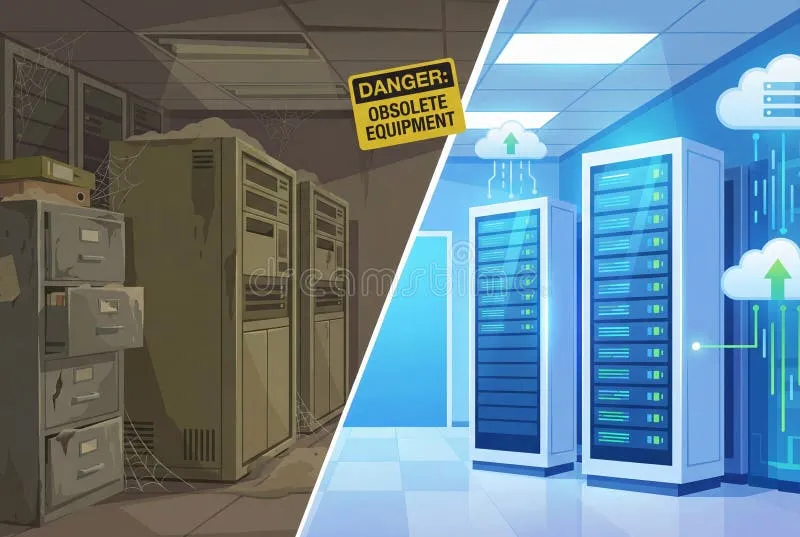
Photo: aging server room dusty legacy mainframe office, via thumbs.dreamstime.com
Every CIO we speak with can name their modernization backlog. Far fewer can name what that backlog costs them each month while it sits there. Legacy systems are the quiet line items of enterprise IT — never a line item at all, in fact, which is precisely the problem. Their expenses are scattered across maintenance contracts, security remediation, cloud waste, and the opportunity cost of engineering hours spent keeping the lights on instead of building the future.
Below are the five drains we encounter most often in US enterprises, along with the modernization approach that retires each one and a realistic timeline for payback.
1. The COBOL Mainframe Nobody Dares Touch
Somewhere between 200 and 220 billion lines of COBOL are still in production globally, and a meaningful share of them process payments, claims, and benefits for American companies. The direct costs are well understood: scarce specialist talent commands premium rates, and mainframe MIPS pricing rises relentlessly. The indirect costs are worse. Every change to downstream systems requires a mainframe change, so the mainframe sets the pace for the entire enterprise.
The modernization approach: Incremental extraction, not big-bang rewrite. Wrap mainframe functionality behind APIs, migrate one business domain at a time to cloud-native services, and run parallel until confidence is earned.
Payback timeline: 12 to 18 months for the first domain, driven by reduced MIPS consumption and eliminated specialist dependency. Full program payback typically lands inside three years.
2. The Custom ERP Extensions Layered on Like Sediment
Twenty years of customizations turn a commercial ERP into something no vendor supports and no internal team fully understands. Upgrade paths become multi-year, seven-figure ordeals, so upgrades simply stop happening — and the vendor's support clock runs out anyway.
The modernization approach: Decouple. Move custom logic out of the ERP core into a containerized service layer, keep the vendor product as close to vanilla as possible, and restore the upgrade path.
Payback timeline: 14 to 20 months, mostly through avoided upgrade costs and the elimination of the specialized contractor bench that exists solely to keep the customization layer breathing.
3. The Abandoned SharePoint Intranet
It started as a document library in 2011. Now it hosts a mission-critical approval workflow that four departments depend on, nobody owns it, and it runs on a server that IT has been meaning to decommission since the last CTO. The cost is not the hosting — it is the compliance exposure of unmanaged data and the forty minutes a day each of three hundred employees loses fighting the workflow.
The modernization approach: Inventory what the intranet actually does, retire the dead weight (usually 70% of it), and rebuild the genuine workflows on supported platforms with proper identity and audit controls.
Payback timeline: 6 to 12 months. This is the fastest win on the list, which makes it an ideal pilot for a modernization partnership.
4. The Point-to-Point Integration Web
Every new system gets wired directly into three older systems. After a decade, the enterprise runs on a hairball of thousands of brittle connections, each one a single point of failure with no documentation. Integration maintenance consumes a third of some IT budgets, and every digital initiative inherits the hairball's fragility as a tax on velocity.
The modernization approach: An event-driven integration layer with managed messaging, API gateways, and contract testing. Not glamorous; transformative.
Payback timeline: 12 to 16 months, measured in reduced integration maintenance hours and — the larger prize — faster delivery on every subsequent project.
5. The On-Premise Infrastructure Held Together by Two People
Every enterprise has a data center whose operational knowledge lives in the heads of one or two veterans approaching retirement. Virtualization licenses are up for renewal, hardware is past end-of-life, and the disaster recovery plan has not been tested since the last administration.
The modernization approach: A staged cloud landing zone with automated infrastructure-as-code, so the knowledge moves from heads into repositories that survive turnover.
Payback timeline: 18 to 24 months for full migration, but risk reduction begins in month one, and many CFOs find the insurance value alone justifies the program.
Why This Is a Partnership Decision, Not a Project
Here is where the ROI math changes. Traditional modernization projects fail for a predictable reason: they are staffed with expensive consultants who leave when the project ends, handing over to internal teams already stretched thin maintaining the very systems being replaced.
A modernization partnership inverts the structure. A dedicated distributed team — for example, a South African delivery hub working in direct overlap with US business hours — carries the modernization program and the run-side operations simultaneously. The same engineers who extract the COBOL domain also support it in production, which removes the classic handover failure and halves the coordination overhead.
The economics compound: sustained partnership rates well below US contractor benchmarks, no ramp-up churn between phases, and a team that gets faster as it accumulates context rather than resetting with every statement of work.
Modernization, done this way, is not a line item you approve once and regret. It is a capability you acquire — one that, on the timelines above, is usually paying its own invoice before the second fiscal year begins.